The Word Mapping Formula
Learn the Mathematical Formula for Mapping Words Bidirectionally
The Word Mapping Formula
Learn how to do this for all words, not just those with correspondences explicitly taught within phonics programmes.

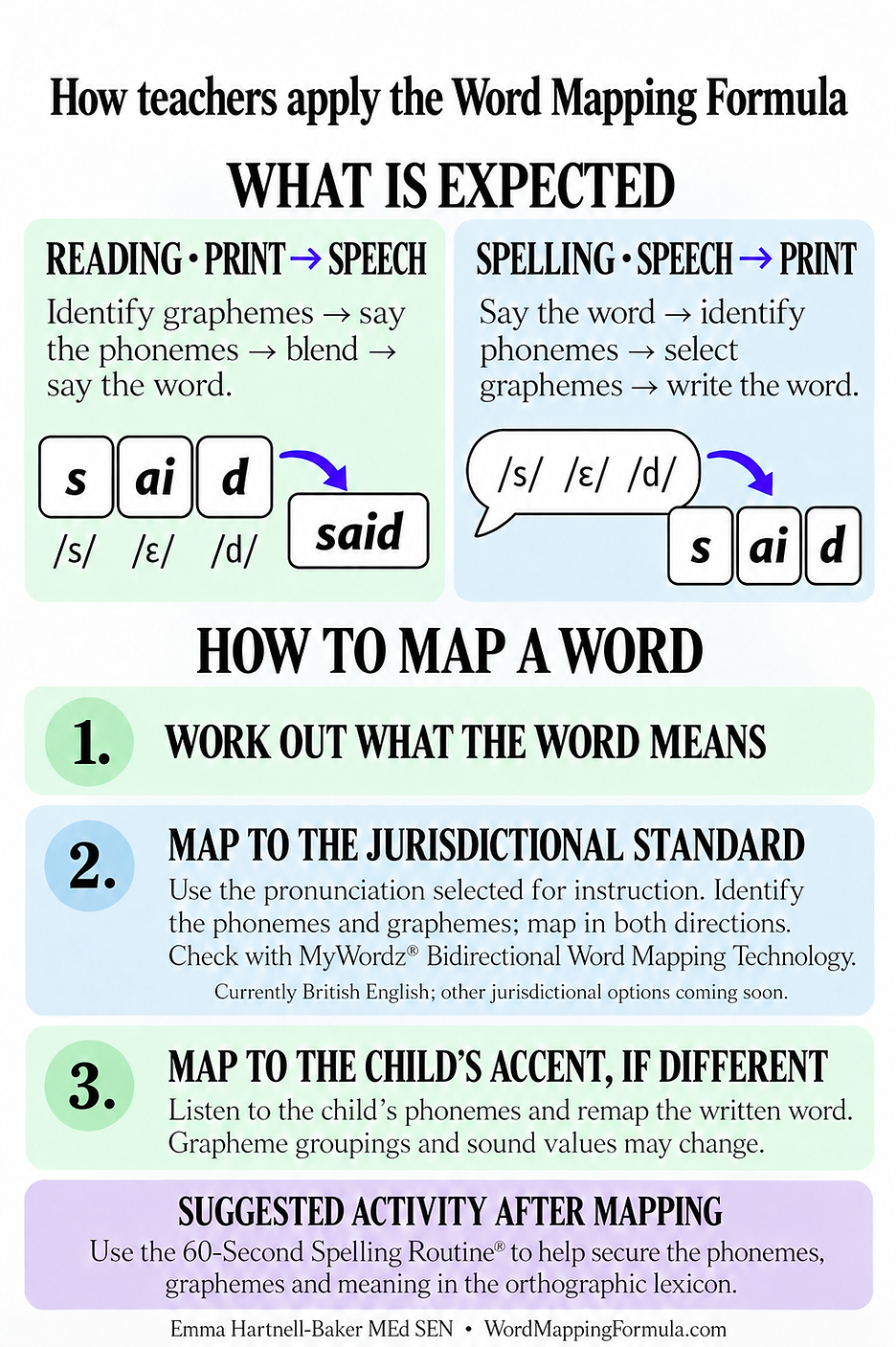
The Bidirectional Word Mapping Formula
Print → speech: Written word → identify the graphemes from left to right → say the phoneme represented by each grapheme → blend the phonemes → say the word.
Speech → print: Spoken word → identify and segment the phonemes in order → select graphemes to represent the phonemes → write the word.
Part 1: Map the jurisdictional standard
First, talk about what the word means. Then show the child its expected mapping in both directions: print to speech and speech to print.
Teachers select the standardised pronunciation relevant to their teaching context, for example British English, Australian English or American English. They identify its constituent phonemes, produce those sounds accurately when saying the segmented sounds and the whole word, and map them to the corresponding graphemes.
Teachers must be able to work with a shared, standardised phonological–orthographic mapping for phonics instruction, even when that pronunciation differs from their own accent. If unsure, check the mapping with the technology.
Part 2: Map the word to the child’s accent, if different
Teachers also need to listen to the sounds the child actually uses. They must take care not to let the letters they see, or the grapheme–phoneme correspondences they expect, influence which sounds they identify. If the child’s pronunciation differs from the instructional standard, the teacher maps that pronunciation too.
Neither is the “right” mapping. The goal is for the child to bond the word’s speech sounds, graphemes and meaning in the orthographic lexicon. The 60-Second Spelling Routine® provides a quick way to do this. It is a judgement call whether, for a particular word and child, the child maps using the standardised pronunciation or their own accent.
Accent differences need to be considered separately from speech and language challenges or what we might call “lazy” pronunciation, such as saying /ækst/ instead of /æskt/ for asked. These distinctions matter when deciding what the child is hearing and saying, and how best to support their mapping.
Showing the standardised mapping can make the word easier to understand because it aligns with the core code used in phonics instruction. In the Speech Sound Pics® (SSP) Approach, this is way of pronouncing words is called the Speech Sound King’s Code. Learners think of the written code as representing “the King’s English”, aligned with RP and British IPA, while also learning to recognise how their own accent maps to the same spelling. The teacher is not telling the child to pronounce the word differently.
This is about supporting self-teaching, rather than teaching children to remember individual words. When they come to spell a new word, children can consider both the sounds they use and how the Speech Sound King would say it. That may help them make a more accurate grapheme choice. They can then check the word with the word-mapping technology. Then they use the 60 Second Spelling Routine to store the word.
Teachers who can competently map words can more easily identify and understand errors like this. In going, the child hears /w/ and tries to account for it separately, not realising that it is already included when they say /əʊ/, represented by ‹o›. Asking children to identify and underline the graphemes helps them see how the word is mapped, while also showing the teacher exactly what the child understands and what needs to be shown.

Teacher Knowledge and the Word Mapping Formula
Moats (1994) found that experienced teachers could struggle to identify elements of spoken language and explain how they are represented in writing. In her later account of the knowledge required for expert reading instruction, Moats (2020) emphasised phonology, sound–symbol correspondences and the structure of written language. She argued that without this knowledge, teachers cannot respond insightfully to pupils’ errors or decide what a lesson needs to address.
A recent example makes the issue concrete. Moats examined a child’s spelling sheet on which high and fight had been written as hing and fing. She was concerned that the teacher had not recognised what these written attempts revealed about the child’s phoneme awareness and understanding of the relationship between speech and print (Luscombe, 2026). The issue she identified was visible in the child’s spelling.
Interpreting an attempt like this requires more than knowing that phonemes matter. A teacher must determine how many phonemes are in the intended word, which letters form its graphemes, and which phoneme or phonemes those graphemes represent. They can then compare the target mapping with the child’s attempt. This is the practical knowledge that connects Moats’ analysis of teacher preparation to decisions about an individual word (Moats, 1994, 2020).
Increasing knowledge through training does not, by itself, demonstrate improved outcomes for children. In a US federal evaluation, an eight-day programme based on LETRS improved aspects of teachers’ knowledge and practice but did not produce significantly higher pupil reading scores after one year (Institute of Education Sciences, 2008). That finding concerns the intervention studied, rather than every version of LETRS. It strengthens the
case for examining whether teachers can apply what they know when analysing words and pupils’ responses.
Emma Hartnell-Baker’s Word Mapping Formula specifies a consistent process for making those decisions. It sets out how to identify phonemes and graphemes, show their correspondences, and map a word in both directions: speech to print and print to speech. It is intended for use by all teachers, with all words and across jurisdictions. The jurisdiction provides the reference standard for instruction, while the phonemes shown for an individual speaker reflect their pronunciation and accent (Hartnell-Baker, n.d.).
The question for teacher preparation is therefore specific: if teachers have a consistent Word Mapping Formula, will they use it when examining a child’s attempts? Will they feel better equipped to identify and show the correspondences that child needs?
Let’s find out. Register your interest in Word Mapping Formula training here
References
Hartnell-Baker, E. (n.d.). The Word Mapping Standard. Show the Code. https://www.showthecode.com/word-mapping-standard
Institute of Education Sciences. (2008). The impact of two professional development interventions on early reading instruction and achievement (NCEE 2008-4030). US Department of Education. https://ies.ed.gov/use-work/resource-library/report/evaluation-report/impact-two-professional-development-interventions-early-reading-instruction-and-achievement
Luscombe, B. (2026, September 23). The woman winning the reading wars. TIME. https://time.com/article/2026/09/23/louisa-moats-letrs-training-reading-interview/
Moats, L. C. (1994). The missing foundation in teacher education: Knowledge of the structure of spoken and written language. Annals of Dyslexia, 44, 81–102. https://doi.org/10.1007/BF02648156
Moats, L. C. (2020). Teaching reading is rocket science: What expert teachers of reading should know and be able to do. American Educator, 44(2), 4–9, 39. https://www.aft.org/ae/summer2020/moats
We offer online and face-to-face Word Mapping Formula training through ShowTheCode.com.
Emma Hartnell-Baker also runs workshops to show teachers how to use MyWordz® technology to check the mapping of words themselves. She teaches them about the IPA so they understand how and why Phonemies® are used as phonetic symbols for orthographic learners: anyone learning to read, spell and communicate in English. Phonemies are known as 'Speech Sound Monsters' by children in Australia, and are being used in a growing number of schools in England, within EHCPs.