The English Alphabetic Code
The Teacher Test of Phonological–Orthographic Mapping (POM)

Mapping the Alphabetic Code with the IPA
Phonetic notation is a system of visual symbols used to represent the sounds of spoken language.
Why We Need a Visual Symbol for Speech Sounds
If teachers are expected to identify the phonemes in words and map them to graphemes, they need a way to represent those phonemes visually.
Letters can't do this job. Letters and letter combinations are the graphemes being mapped. If we use another spelling to represent the sound, we immediately introduce ambiguity. For example, writing “or” to represent a sound doesn't tell us whether we mean the phoneme itself or the grapheme ‹or›.
This is why we need phonetic symbols.
The International Phonetic Alphabet (IPA) provides a system of symbols for representing speech sounds independently of spelling. It allows us to distinguish clearly between:
the phoneme: /ɔː/
the graphemes representing it: ‹or›, ‹ore›, ‹our›, ‹oar›, ‹aw›, ‹au› etc.
This distinction matters when we are asking teachers to map the alphabetic code consistently.
Whose phonemes?
There are two things teachers need to be able to do.
They need a shared reference mapping so that everyone can see what is meant when a particular grapheme–phoneme correspondence is identified. This is the purpose of the nationally agreed mapping we are working towards, aligned with the relevant British, Australian or American English IPA reference pronunciation. In England, most phonics programmes broadly use British English pronunciation, although they don't generally use IPA symbols to make every intended phoneme explicit.
But teachers also need to be able to identify the phonemes actually being used in speech, including their own pronunciation and that of their pupils.
Those aren't contradictory requirements.
A shared reference tells us:
How is this word mapped according to the agreed reference pronunciation?
Listening to the speaker tells us:
How does this child or adult actually pronounce and therefore phonologically map this word?
The IPA gives us a way to record both.
Why symbols matter
Without a symbol system, discussions about the alphabetic code can become circular. We use letters to describe sounds, while simultaneously trying to determine which letters represent those sounds.
Using IPA separates the two:
speech → phoneme /ɔː/ → grapheme ‹our› → pour
Now everyone can see exactly which sound is being discussed and exactly which letter or letters are representing it.
Teachers don't need to become phoneticians or memorise the entire International Phonetic Alphabet. They need access to the small set of IPA symbols relevant to the English phonemes they are mapping, together with the ability to recognise when the pronunciation in front of them differs from the reference pronunciation.
The goal is not to make teachers transcribe speech for its own sake. The symbols give us a shared visual language for the sounds so that we can map the alphabetic code consistently, while still recognising the speech of the individual child.
Why this matters for teacher testing, training and research
This is particularly important for the Teacher Test of Phonological–Orthographic Mapping (POM).
We need to establish not only whether teachers can identify the graphemes in a word, but whether they can identify the phonemes those graphemes represent. We also need to distinguish a difference in knowledge from a genuine difference in pronunciation.
The technology enables teachers to say the sounds they identify. Those spoken responses are recorded and represented using phonetic symbols, giving us a visual and machine-readable record of the phonemes the teacher identified. We can then compare those phonemes with the graphemes they selected and with the agreed reference mapping.
This is important because we want to analyse responses at scale.
Rather than recording only whether an answer was right or wrong, we can examine patterns in how teachers identify and map phonemes and graphemes. We can identify where teachers are struggling, where responses differ because of accent, and where there may be wider inconsistencies in how the alphabetic code is understood or taught.
The same information can then inform training. Teachers can see the phonemes they are identifying, compare their own pronunciation with the agreed reference pronunciation, and develop greater confidence in mapping words bidirectionally.
The IPA is therefore not something we are asking teachers to learn for its own sake. It gives us a shared visual and digital language for the phonological side of phonological–orthographic mapping.
If we want to test, analyse and develop teachers' knowledge of phonemes and graphemes, we need to be able to see and record both.
The DfE already uses phonetic symbols
The Department for Education already uses phonetic notation, for example in the Phonics Screening Check (PSC) guidance. The DfE states that “all plausible alternative and regional pronunciations are acceptable” and, in the table, uses phonemic representations to show examples of pronunciations it identifies as acceptable.
For example, for dup, the guidance describes the pronunciation using the “d” from dig and states that the word rhymes with cup. It then provides the phonemic representations /dʌp/ or /dʊp/.
This illustrates exactly why phonetic symbols are needed.
Simply writing “rhymes with cup” assumes that the reader pronounces cup in a particular way. One child might say:
cup → /k/ /ʌ/ /p/
while another might say:
cup → /k/ /ʊ/ /p/
The written word cup is identical in both cases. It is the phonemes being produced that differ. The grapheme ‹u› therefore cannot tell us which vowel sound the child is using.
The phonetic symbols can.
This is particularly significant because the DfE expects teachers administering the PSC to recognise plausible alternative and regional pronunciations. The DfE itself uses phonemic representations to make examples of acceptable pronunciations explicit.
Yet we don't currently know whether teachers understand these symbols or can independently identify the phonemes they hear in a child's speech.
That matters for phonological–orthographic mapping. If teachers are expected to determine whether a child's pronunciation is acceptable, giving them another written word as the pronunciation reference doesn't resolve the problem if the teacher and child pronounce that reference word differently.
Phonetic notation gives us a way to show exactly which speech sound is intended, independently of the letters used to spell it.


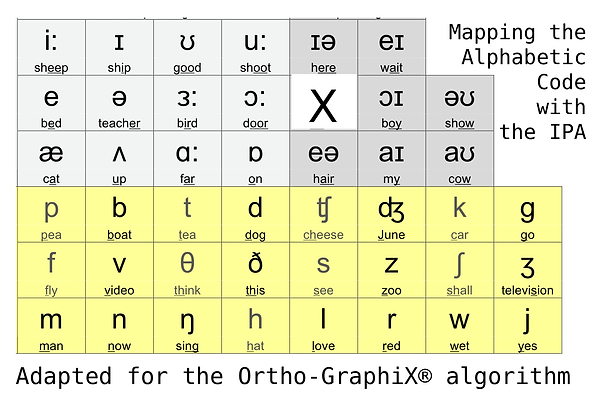
The DfE example GPC teaching progression does not use /ʊə/ as a separate phoneme. Words that might traditionally have been mapped using /ʊə/ are instead mapped according to their current pronunciation. For example, pour is grouped with daughter, oar and more under the same GPC, with ‹our› representing the same vowel sound as ‹oar› in oar and ‹ore› in more.
When the DfE’s phonics notation is transcribed into British IPA for our reference mapping, this vowel is represented as /ɔː/. Consequently, /ʊə/ is absent from our British IPA phoneme set. This reflects the DfE’s current mapping rather than the older analysis in which /ʊə/ was treated as a separate phoneme.
The DfE has used IPA in phonics and word-mapping guidance for decades
The use of phonetic symbols by the Department for Education extends beyond the Phonics Screening Check.
The National Curriculum in England: English Programmes of Study, published in September 2013, includes an International Phonetic Alphabet (IPA) chart at the end of English Appendix 1: Spelling. The chart is non-statutory and shows IPA symbols alongside examples of the associated graphemes.
The DfE explains:
“The table is not a comprehensive alphabetic code chart; it is intended simply as guidance for teachers in understanding the IPA symbols used in the spelling appendix.”
It also explicitly acknowledges accent variation:
“The pronunciations in the table are, by convention, based on Received Pronunciation and could be significantly different from other accents.”
The use of IPA specifically in relation to teachers' knowledge of phonics had already been raised with the Department a decade earlier.
In 2003, the late Professor Greg Brooks, Emeritus Professor of Education at the University of Sheffieldrecommended that the then Department for Education and Skills:
“Investigate incorporating International Phonetic Alphabet training into initial and continuing teacher education.”
The DfES response records that Brooks suggested that decisions about which phonemes were included in phonics guidance should be reconsidered and that teachers should be informed about the International Phonetic Alphabet.
Brooks continued to advocate this approach and, in 2011, published a chapter specifically titled “Using the International Phonetic Alphabet to support accurate phonics teaching.”
The DfE uses IPA “for clarity”, but says practitioners don't need to understand it
IPA also appears in DfE Functional Skills English subject content. Its word-reading tables explicitly pair written letters and letter combinations with IPA symbols. For example, ‹p› and ‹pp› are mapped to /p/, and ‹c›, ‹k› and ‹ck› to /k/.
The guidance explains that:
“the sounds are shown using the symbols of the International Phonetic Alphabet (IPA) for clarity.”
However, it then states that practitioners don't need to understand the symbols because the underlined letters in example words indicate the sounds.
That presents the very problem we are investigating.
An underlined letter or letter combination identifies the grapheme, but it doesn't independently identify the phoneme. If two people pronounce the example word differently, the spelling itself cannot tell us which speech sound each person is using.
For example, showing ‹u› in cup does not tell us whether the speaker is using /ʌ/ or /ʊ/. The written word is identical. The phonological representation is not.
This means that using written words to identify speech sounds can leave the intended phoneme dependent on the reader's own pronunciation.
Why isn't IPA used in the Reading and Writing Frameworks?
The absence of IPA from the DfE's current Reading and Writing Frameworks is particularly significant because these are the documents currently guiding primary teachers in reading, phonics and spelling.
The Reading Framework (2023) explicitly states that its alphabetic code chart does not use the International Phonetic Alphabet:
“To reflect different regional accents, the chart does not use the International Phonetic Alphabet (IPA).”
Instead, phonemes are represented using familiar spellings between slashes, such as /sh/, /ch/ and /or/.
But regional variation is precisely where the distinction between a speech sound and its spelling becomes important.
IPA doesn't require everyone to pronounce a word in the same way. It enables different pronunciations to be represented. A reference pronunciation can be represented using one phonemic transcription, while the phonemes actually used by a teacher or child can also be identified and represented.
The Writing Framework (2025) places phoneme–grapheme mapping at the heart of early spelling. Pupils are expected to say words, segment them into phonemes and select graphemes to represent those phonemes.
Yet teachers aren't given a consistent, independent visual notation for the phonemes they are expected to identify and map.
This leaves us with an important question:
If teachers are expected to identify phonemes and graphemes and map between them in both directions, how are they expected to represent the phonological side of that mapping consistently?
Using letters or example words to represent sounds brings us back to the orthography. It also assumes that the teacher knows which sound is intended and that their pronunciation of the example word matches the pronunciation being referenced.
The DfE's stated reason for avoiding IPA in the Reading Framework is particularly interesting in this context. Accent variation isn't a reason that phonetic notation cannot be used. It is one of the reasons a way of representing different pronunciations is useful.
The lack of a consistent visual representation of phonemes may be one reason teachers are unsure how to map words when they move beyond the GPCs explicitly taught within their phonics programme. This is one of the questions our research is investigating.
From identifying the problem to supporting teachers
The use of IPA to make the phonological side of phoneme–grapheme correspondences explicit isn't new to DfE documentation. Nor is the proposal that teachers should receive training in it.
What appears to be missing is a consistent approach that enables teachers to identify, represent and discuss the phonemes they are mapping independently of the orthography, including when their own pronunciation or a child's pronunciation differs from a reference pronunciation.
We will therefore include training in the relevant IPA symbols as part of our work on phonological–orthographic mapping.
We will also propose that a working knowledge of the IPA symbols needed to represent English phonemes becomes a mandatory component of phonics teacher training and initial teacher education in England.
The aim isn't to turn teachers into phoneticians or require them to learn the entire IPA. It is to give teachers a shared visual language for the phonological side of the alphabetic code, so that when we ask:
Which phoneme? Which grapheme?
both sides of that mapping can be made explicit.
What is the sound value for <a> in these spoken words?
Is this child using these sounds?
/pæn/

WORD-MAPPING TECHNOLOGY ALSO REQUIRES AN AGREED STANDARD
Technology can give teachers immediate access to the bidirectional mapping of words at the point of need.
We currently provide teachers with word-mapping technology and training using Ortho-GraphiX®, enabling them to check the phonological-orthographic mapping of words for reading and spelling, including words containing correspondences outside those explicitly taught within their phonics programme.
But the need for clear and consistent guidance applies as much to us as technology developers as it does to teachers.
If we provide a teacher with the mapping of a word, we need to know that the analysis being displayed reflects the phonological-orthographic principles that teacher is expected to apply.
We cannot simply decide what the mapping should be.
This becomes particularly important when pronunciation differs between varieties of English. The phonemes present in a British English pronunciation of a word may not be identical to those present in an Australian English pronunciation. The child may have a totally dfferent accent. If the phonological representation changes, the mapping may also change.
The reference pronunciation therefore needs to be explicit.
This principle is already built into the Teacher Test of Phonological-Orthographic Mapping. In Part 2, teachers select the reference variety they are being assessed against, for example Australian English or British English, listen to the supplied pronunciation, and map that pronunciation to the written word.
The same principle needs to apply to word-mapping technology.
For an Australian English setting, we need to know:
Which pronunciation is the reference?
Which phoneme inventory and IPA representation should be used?
What constitutes a grapheme within the required analysis?
How should consonant clusters, digraphs and so-called silent letters be mapped?
How should every letter in the written word be accounted for?
Should the same underlying mapping principles apply bidirectionally for decoding and encoding?
Without clear answers, technology could confidently display a mapping that does not correspond with the analysis expected of the teacher using it. That would be unacceptable.
This is therefore not simply a question of ensuring that teachers know the code. It is also necessary to ensure that the training, assessment and technology used to support them are all working from the same agreed code-mapping standard.
Technology can apply an agreed formula consistently and at scale. It should not be responsible for determining what that formula is.
The formula must come first.
Once the word mapping standard is sufficiently explicit, it can provide a common reference for teacher knowledge, teacher training, the Teacher Test and the word-mapping technology itself.